

5-Star Hotel Furniture Requirements: Standards & Specifications Guide
For hotel owners, developers, interior designers, procurement managers, and project consultants, furniture selection for a five-star hotel is never only about appearance. It is about brand positioning, guest experience, durability, safety, comfort, maintenance, and long-term operational performance. Understanding 5 star hotel furniture requirements helps project teams define the right specifications before quotation, sampling, production, quality inspection, and installation.
A five-star hotel room, lobby, restaurant, suite, or resort villa must deliver a higher standard than ordinary commercial furniture. Every chair, sofa, bed, nightstand, desk, wardrobe, headboard, minibar cabinet, and loose furniture piece must support the overall hotel identity. The furniture should look refined, feel comfortable, perform reliably, and stay consistent across all rooms and public areas.
This guide explains the major requirements for five-star hotel furniture, including brand standards, material specifications, fire safety, testing, durability, mock-up approval, and practical project examples. It is written for buyers who need to turn design concepts and BOQs into real furniture that can be manufactured, delivered, installed, and used in daily hotel operations.
What Do 5 star hotel furniture requirements Usually Include?
Five-star hotel furniture is usually evaluated through a combination of design, engineering, material, safety, and service requirements. A beautiful rendering is only the beginning. The furniture must also meet the physical, technical, and operational demands of a luxury hospitality environment.
In most projects, the requirements include:
| Requirement Area | What It Means for Hotel Furniture |
|---|---|
| Brand positioning | Furniture must match the hotel’s luxury level and design identity |
| Durability | Products must withstand frequent guest use and housekeeping cycles |
| Comfort | Seating, beds, and upholstery must support a premium guest experience |
| Fire safety | Upholstered items may need project-specific fire-retardant documentation |
| Material quality | Veneer, fabric, leather, metal, stone, foam, and hardware must be controlled |
| Dimensional accuracy | Furniture must match drawings, room layouts, and installation conditions |
| Batch consistency | Repeated rooms must look visually consistent |
| Maintenance | Materials should be cleanable, repairable, and suitable for hotel operations |
| Packaging | Export packaging must protect furniture during long-distance shipping |
| Documentation | Samples, test reports, QC records, packing lists, and warranties may be required |
For a five-star project, the supplier should not only provide products. The supplier should support the project from specification review to material selection, sampling, production, inspection, export packaging, and final delivery.
Why Five-Star Furniture Standards Are Different
Five-star hotels operate under higher expectations. Guests expect comfort, silence, visual harmony, and quality details. Hotel owners expect a strong brand image and long service life. Operators expect easy maintenance and reliable daily performance. Designers expect the final product to match the approved design intent.
This creates a more demanding furniture standard than ordinary residential or low-budget commercial projects.
A standard guest chair may only need to look acceptable in a normal room. A five-star guest chair must match the interior concept, feel comfortable, withstand heavy use, meet safety requirements, clean easily, and remain consistent across hundreds of rooms. A lobby sofa must not only look luxurious; it must also keep its shape, resist stains, support repeated use, and maintain a premium appearance under high traffic.
The difference is often hidden inside the product. Internal frame strength, foam density, upholstery method, stitching detail, hardware quality, veneer selection, lacquer finish, and edge treatment all influence long-term performance.
Five-star hotel furniture must be built for both luxury and operation. It should look refined, but it must also survive real hotel life.
Brand Standards and Operator Requirements
Many five-star hotels are managed by international hotel groups or high-end independent operators. These brands usually have specific requirements for design consistency, room functionality, material performance, guest comfort, fire safety, and maintenance.
Brand-level 5 star hotel furniture requirements may vary depending on the hotel group, country, project type, and interior design concept. Some brands provide detailed technical standards. Others rely on the designer, owner, procurement consultant, or operator to define the specification.
Common brand-related requirements include:
| Brand Requirement | Furniture Impact |
| Guest experience | Furniture must support comfort, usability, and luxury perception |
| Design language | Shapes, proportions, colors, and finishes must match the concept |
| Room efficiency | Furniture must support circulation, storage, and housekeeping |
| Durability | Materials must perform under commercial use |
| Safety | Edges, stability, fire performance, and installation must be reviewed |
| Maintenance | Parts should be repairable or replaceable where possible |
| Consistency | Guest rooms, suites, and public areas must follow the brand image |
| Documentation | Samples, specifications, and approvals must be recorded |
For example, a luxury resort may require softer natural textures, outdoor-resistant materials, and larger lounge furniture. A city business hotel may need more compact casegoods, efficient desks, and durable surfaces. A branded five-star hotel may require mock-up room approval before mass production.
The furniture supplier must understand these differences before preparing a quotation.
Material Specifications for Five-Star Hotels
Material selection is one of the most important parts of five-star hotel furniture procurement. Materials affect appearance, price, durability, comfort, maintenance, and guest perception.
Common material categories include:
| Material Category | Five-Star Specification Focus |
| Wood veneer | Grain consistency, color matching, surface protection |
| Solid wood | Stability, moisture control, structure, visible detail |
| Engineered panels | Strength, flatness, environmental performance, edge sealing |
| Metal | Finish consistency, corrosion resistance, welding quality |
| Stone | Natural veining, thickness, edge treatment, sealing |
| Fabric | Abrasion resistance, color fastness, stain resistance, fire performance |
| Leather | Grade, texture, thickness, color consistency, maintenance |
| Foam | Density, resilience, comfort, deformation resistance |
| Hardware | Smooth movement, durability, soft-closing function, corrosion resistance |
| Glass | Thickness, safety treatment, edge polishing |
A five-star hotel does not always need the most expensive material everywhere. The right approach is to use premium materials where guests can see and touch them, while optimizing hidden structures for strength and cost control.
For example, a visible nightstand surface may use high-quality veneer or lacquer, while the internal structure can use stable engineered material. A suite coffee table may use natural stone because it is a strong visual point. A guest room desk may use a durable finish that resists scratches and cleaning chemicals.
Material selection should always balance beauty, practicality, budget, and long-term hotel operation.
Upholstery and Fabric Requirements
Upholstered furniture plays a major role in guest comfort and visual softness. Sofas, lounge chairs, headboards, dining chairs, benches, banquettes, and cushions are all key touchpoints in a five-star hotel.
For luxury hotel upholstery, fabric should not be selected only by color or texture. It should also be reviewed for performance.
Important fabric and upholstery requirements include:
| Requirement | Why It Matters |
| Abrasion resistance | Helps the fabric withstand frequent use |
| Pilling resistance | Keeps the surface clean and premium-looking |
| Color fastness | Reduces fading or color transfer |
| Stain resistance | Supports housekeeping and long-term maintenance |
| Fire performance | May be required by local regulation or brand standard |
| Hand feel | Affects guest comfort and luxury perception |
| Batch consistency | Keeps repeated rooms visually aligned |
| Cleaning method | Must match hotel maintenance procedures |
Foam is equally important. A five-star sofa or lounge chair should not collapse quickly after repeated use. Foam density, resilience, layering, and shape recovery should be reviewed during sampling. A seat can look beautiful in a photo, but if the foam is too soft, too hard, or too weak, the guest experience will suffer.
Upholstery craftsmanship also matters. Stitching lines should be straight, seams should be controlled, cushions should keep their shape, and fabric direction should be consistent. These details are especially visible in luxury interiors.
Fire Safety and Testing Requirements
Fire safety is a critical part of hotel furniture specifications. Requirements vary by country, local authority, hotel operator, building type, and project consultant. Upholstered seating, headboards, banquettes, mattresses, curtains, and soft materials may all be reviewed differently.
Commonly referenced standards may include BS 5852, EN 1021, CA TB 117, or other local fire safety requirements. The final standard should always be confirmed by the project fire consultant or relevant authority before quotation and sampling.
A key point is that fire performance may apply to the full material combination, not only the fabric. Upholstered furniture can include cover fabric, foam, filling, barrier cloth, thread, adhesive, and frame structure. A fabric-only certificate may not be enough if the project requires composite testing.
For five-star projects, the BOQ should clearly state:
| BOQ Fire Requirement | Recommended Detail |
| Product scope | Sofa, chair, headboard, banquette, cushion, or other upholstered item |
| Required standard | BS 5852, EN 1021, CA TB 117, or project-specific standard |
| Testing scope | Fabric only or full upholstery composite |
| Material combination | Fabric, foam, barrier, filling, and backing |
| Documentation | Lab report, certificate, label, or material record |
| Approval stage | Before sampling, before production, or before shipment |
Fire requirements should not be left until the end of the project. If the wrong fabric or foam is selected early, the sample may need to be remade, the quotation may change, and the production schedule may be delayed.
Durability and Performance Testing
Five-star hotel furniture should be tested or reviewed for commercial performance. Not every project requires formal laboratory testing for every item, but the supplier should have a clear quality control process.
Performance review may include:
| Test or Review Area | Purpose |
| Frame strength | Ensures seating and casegoods are stable |
| Seat durability | Checks foam recovery and long-term comfort |
| Fabric abrasion | Evaluates resistance to repeated use |
| Color fastness | Reduces fading and color transfer |
| Hardware cycling | Tests drawers, hinges, and doors |
| Surface resistance | Reviews scratch, moisture, stain, and cleaning performance |
| Load-bearing review | Confirms bed bases, benches, and chairs are structurally safe |
| Stability check | Reduces wobbling, tipping, or uneven installation |
| Packaging test | Confirms protection during transport |
In addition to testing, mock-up review is essential. A mock-up room allows the owner, designer, operator, and supplier to check whether the furniture works in the real room environment.
During mock-up review, the team can confirm:
| Mock-Up Review Item | What to Check |
| Visual match | Does the product match the rendering and material board? |
| Proportion | Does the size fit the room properly? |
| Comfort | Are seating height, softness, and support correct? |
| Function | Do drawers, doors, sockets, and storage areas work well? |
| Maintenance | Can housekeeping clean and access the furniture easily? |
| Safety | Are edges, stability, and installation details acceptable? |
| Installation | Can the product be moved, assembled, and placed correctly? |
A mock-up room helps prevent large-scale mistakes before mass production begins.
Guest Room Furniture Specifications
Guest rooms are the most repeated area in most hotel projects. This makes consistency and cost control especially important. Even a small mistake in one product can be repeated across dozens or hundreds of rooms.
Typical five-star guest room furniture may include:
| Item | Specification Focus |
| Headboard | Design feature, upholstery detail, wall alignment, lighting coordination |
| Bed base | Structural strength, mattress support, quietness, durability |
| Nightstand | Drawer function, socket coordination, finish consistency |
| Desk | Work comfort, cable management, scratch resistance |
| Desk chair | Ergonomics, upholstery durability, stability |
| Lounge chair | Comfort, fabric performance, visual identity |
| Coffee table | Edge safety, surface durability, proportion |
| Luggage bench | Load-bearing strength, fabric or leather durability |
| Wardrobe | Storage layout, hardware quality, ventilation |
| Minibar cabinet | Appliance space, heat ventilation, door function |
The guest room must feel refined but also practical. Guests should be able to move easily, use the furniture intuitively, charge devices conveniently, store luggage, and rest comfortably.
The furniture should also support the hotel team. Housekeeping should be able to clean around items quickly. Maintenance teams should be able to replace small parts if needed. Operators should be able to reorder or repair products in the future.
Public Area Furniture Specifications
Public areas create the strongest first impression. Lobby sofas, lounge chairs, restaurant chairs, bar stools, banquet seating, coffee tables, side tables, and outdoor furniture must carry the hotel’s visual identity.
Public area furniture usually faces heavier use than guest room furniture. A lobby chair may be used by many different guests every day. A restaurant chair may be moved repeatedly. A bar stool may face spills, friction, and cleaning chemicals. Outdoor furniture may face sunlight, rain, humidity, and temperature changes.
Key public area requirements include:
| Area | Furniture Focus |
| Lobby | Visual impact, comfort, durability, stain resistance |
| Restaurant | Easy cleaning, stable structure, commercial fabric |
| Bar | Strong frame, footrest protection, stain resistance |
| Banquet area | Stackability, movement, fabric durability |
| Lounge | Comfort, luxury texture, long-term shape retention |
| Outdoor area | UV resistance, water resistance, quick-dry materials |
| Corridor | Compact size, safety, easy maintenance |
For public areas, designers often want more unique furniture. This is possible, but the supplier must review engineering feasibility. Curved sofas, large stone tables, metal bases, special fabrics, and oversized lounge pieces may require additional structure review and packaging planning.
Case-Based Specification Example
A five-star resort project may require guest room furniture, suite furniture, lobby seating, restaurant chairs, outdoor lounge furniture, and custom public area pieces.
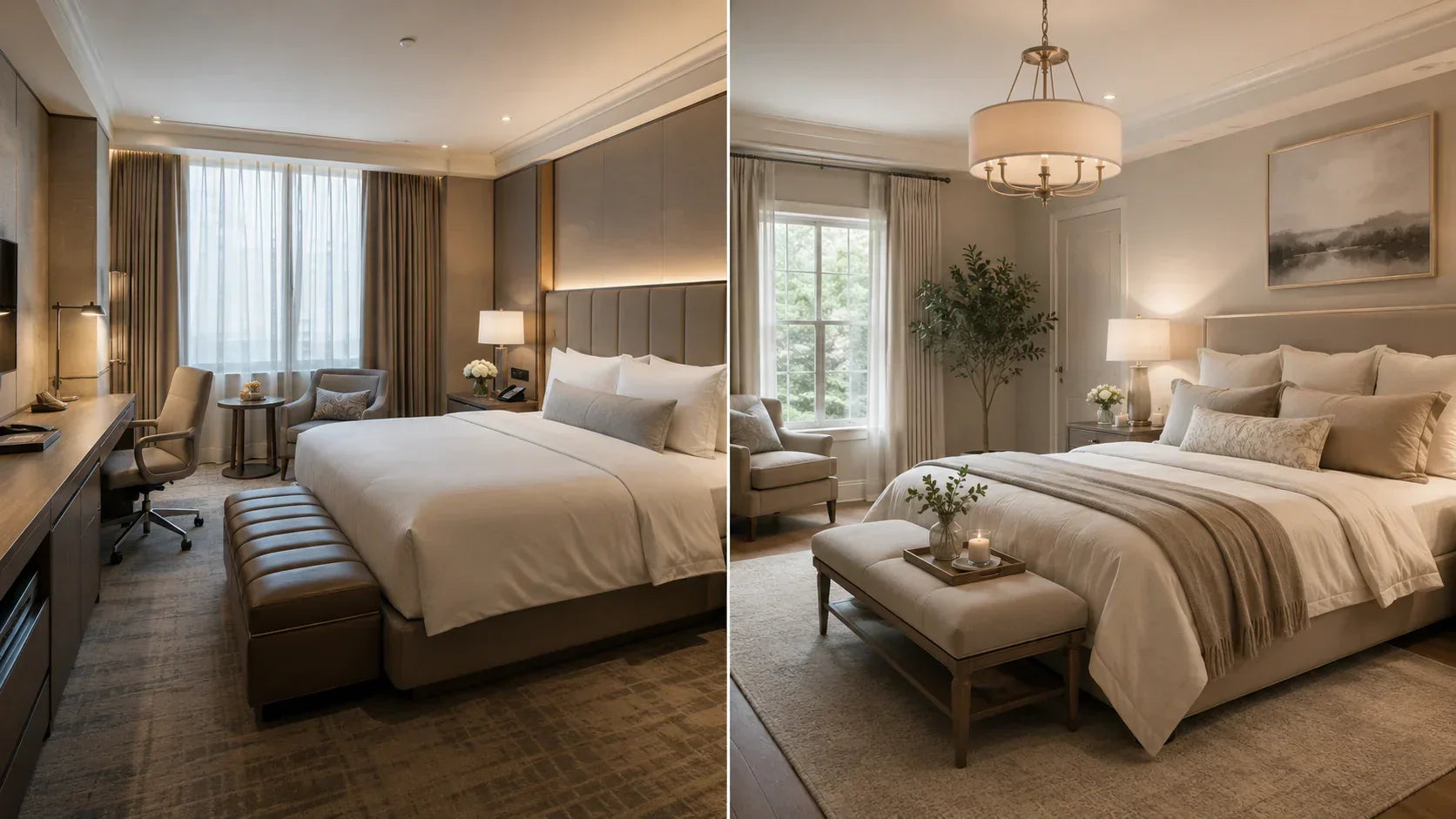
The guest room may use a warm wood veneer, upholstered headboard, custom nightstands, a writing desk, lounge chair, luggage bench, and wardrobe cabinet. The suite may add a sofa, coffee table, dining table, minibar cabinet, console, and decorative side tables. The lobby may require large custom sofas, lounge chairs, marble coffee tables, and accent pieces.
In this type of project, the supplier should not quote only by reference images. The correct process should include drawing review, BOQ clarification, material board preparation, sample production, mock-up confirmation, mass production, QC inspection, export packaging, and delivery coordination.
A practical specification package may include:
| Specification Package | Content |
| Drawings | CAD details, dimensions, elevations, installation notes |
| BOQ | Product codes, quantities, room types, locations |
| Material board | Veneer, fabric, leather, metal, stone, hardware |
| Sample approval | Physical sample or mock-up product |
| Test documents | Fire, abrasion, color fastness, or project-required reports |
| Production standard | Approved dimensions, finishes, and construction details |
| QC records | Photos, videos, inspection reports |
| Packing list | Carton number, item code, dimensions, weight |
| Installation guide | Room labels, assembly notes, placement drawings |
This case logic shows why a five-star project needs a complete manufacturing and procurement system, not only product sourcing.
Quality Control and Documentation
Quality control is one of the strongest differences between standard furniture purchasing and five-star hotel project delivery. The project team needs clear records from sample approval to final shipment.
A good QC process should include:
| QC Stage | What Should Be Controlled |
| Material arrival | Fabric, veneer, metal, stone, hardware, foam |
| Pre-production | Drawings, dimensions, production method |
| In-process inspection | Structure, upholstery, painting, assembly |
| Final inspection | Appearance, dimensions, function, quantity |
| Packaging inspection | Protection, labels, carton condition |
| Shipment documents | Packing list, invoice, export documents, photos |
| After-sales records | Spare parts, repair method, future reordering |
For overseas projects, documentation is especially important because the buyer may not be able to inspect every item in person. Photos, videos, material labels, and QC records help create transparency.
Five-star projects should also keep approved material samples. If future replacement or expansion is needed, these records help maintain consistency.
How CC Furniture Supports Five-Star Hotel Projects
For five-star hotel and commercial projects, CC Furniture supports clients from design review to production and delivery. The goal is not only to make furniture, but to help project teams turn drawings, renderings, and BOQs into reliable manufactured products.
Our team can support material selection, structure review, sample development, customization, production coordination, quality inspection, export packaging, and shipment preparation. For overseas hotel buyers, this full-chain approach can reduce communication risk and help the project move more smoothly from concept to delivery.
Because five-star projects involve design, material, safety, comfort, and operation, the supplier must understand both aesthetics and manufacturing reality. A beautiful design must be translated into practical construction, stable materials, controlled dimensions, and durable finishes.
For hotel owners, designers, and procurement teams, a reliable manufacturing partner should help answer practical questions: Is this material suitable for heavy use? Can this shape be produced consistently? Does this fabric meet the project requirement? Is the packaging strong enough for export? Can the product be installed safely on site?
This is where full-process project support becomes valuable.
Recommended Image ALT Text
- five star hotel guest room furniture specification with custom headboard and nightstands
- luxury hotel furniture material board with veneer fabric leather metal and stone samples
- custom lobby sofa for five-star hotel public area furniture project
- fire retardant upholstery fabric and foam samples for hotel furniture testing
- five-star hotel mock-up room furniture inspection before mass production
Suggested Internal Links
- Custom Hotel Furniture Project Solution
- Hotel Furniture Manufacturer in China
- Hotel Furniture Cost Per Room Budget Guide
- Hotel Furniture Fire Retardant Standards
- Hotel Furniture vs Residential Furniture
- Complete FF&E Procurement Process for Hotel Projects
- Contact Us for Hotel Project Quotation
Conclusion
A clear understanding of 5 star hotel furniture requirements helps owners, designers, and procurement teams make better decisions before production begins. Five-star hotel furniture must combine luxury design, commercial durability, fire safety, comfort, material consistency, quality control, and reliable delivery.
The best furniture solution is not simply the most expensive one. It is the one that matches the hotel’s brand positioning, guest experience, operation needs, safety requirements, and long-term maintenance plan.
For a successful five-star project, confirm the standards early, prepare a detailed BOQ, review materials carefully, approve samples before mass production, inspect before shipment, and work with a manufacturer that understands hospitality project delivery.
Need support for your five-star hotel furniture project?
Share your BOQ, drawings, renderings, material requirements, room type schedule, or project location with our team. We can help review your specifications, recommend practical material solutions, and prepare a custom quotation for your hotel, resort, villa, or commercial space.
FAQ
1. What furniture is usually included in a five-star hotel guest room?
A five-star guest room usually includes a bed base, headboard, nightstands, desk, desk chair, lounge chair, coffee table, luggage bench, wardrobe, minibar cabinet, mirror, and sometimes custom wall panels or suite furniture.
2. What materials are commonly used in five-star hotel furniture?
Common materials include natural veneer, engineered wood panels, solid wood details, commercial-grade fabric, leather, metal, stone, glass, high-resilience foam, premium hardware, and protective surface finishes.
3. Do five-star hotels require fire-retardant furniture?
Many hotel projects require fire-retardant materials or fire test documentation, especially for upholstered furniture. The exact requirement depends on the country, local authority, hotel operator, consultant, and product type.
4. Why is mock-up approval important for five-star hotel projects?
Mock-up approval allows the owner, designer, operator, and supplier to check appearance, comfort, dimensions, function, material, installation, and maintenance before mass production. It helps prevent large-scale mistakes.
5. How are five-star hotel furniture specifications different from residential furniture?
Five-star hotel furniture must perform under commercial use. It usually requires stronger structure, better durability, controlled dimensions, fire safety review, batch consistency, easier maintenance, and project-level documentation.
6. What should buyers prepare before requesting a quotation?
Buyers should prepare drawings, BOQ, renderings, room type schedule, reference images, material preferences, project location, target delivery timeline, and any brand or fire safety requirements.
7. How can a manufacturer support a five-star hotel project?
A manufacturer can support design review, material selection, sample development, production planning, QC inspection, packaging, export documents, and delivery coordination. For custom projects, factory-level control is very important.
8. What is the biggest risk in five-star hotel furniture procurement?
The biggest risk is approving design or price without confirming technical details. If dimensions, materials, fire requirements, samples, or production standards are unclear, the project may face delays, rework, or quality inconsistency.


Leave a comment
This site is protected by hCaptcha and the hCaptcha Privacy Policy and Terms of Service apply.