

Custom Furniture Design Process: From Sketch to Shop Floor (7 Steps)
For hotel owners, interior designers, villa clients, contractors, and furniture brands, turning a furniture idea into a finished product is not as simple as sending a reference image to a factory. A beautiful sketch needs to become a practical structure. A rendering needs to become measurable drawings. A fabric direction needs to become approved material samples. A design concept needs to survive production, inspection, packing, shipping, and installation.
Understanding the custom furniture design process helps buyers reduce mistakes before production begins. It also helps designers, procurement teams, and manufacturers communicate clearly at every stage. When the process is structured, the final result is more likely to match the original design intent, budget, timeline, and project requirements.
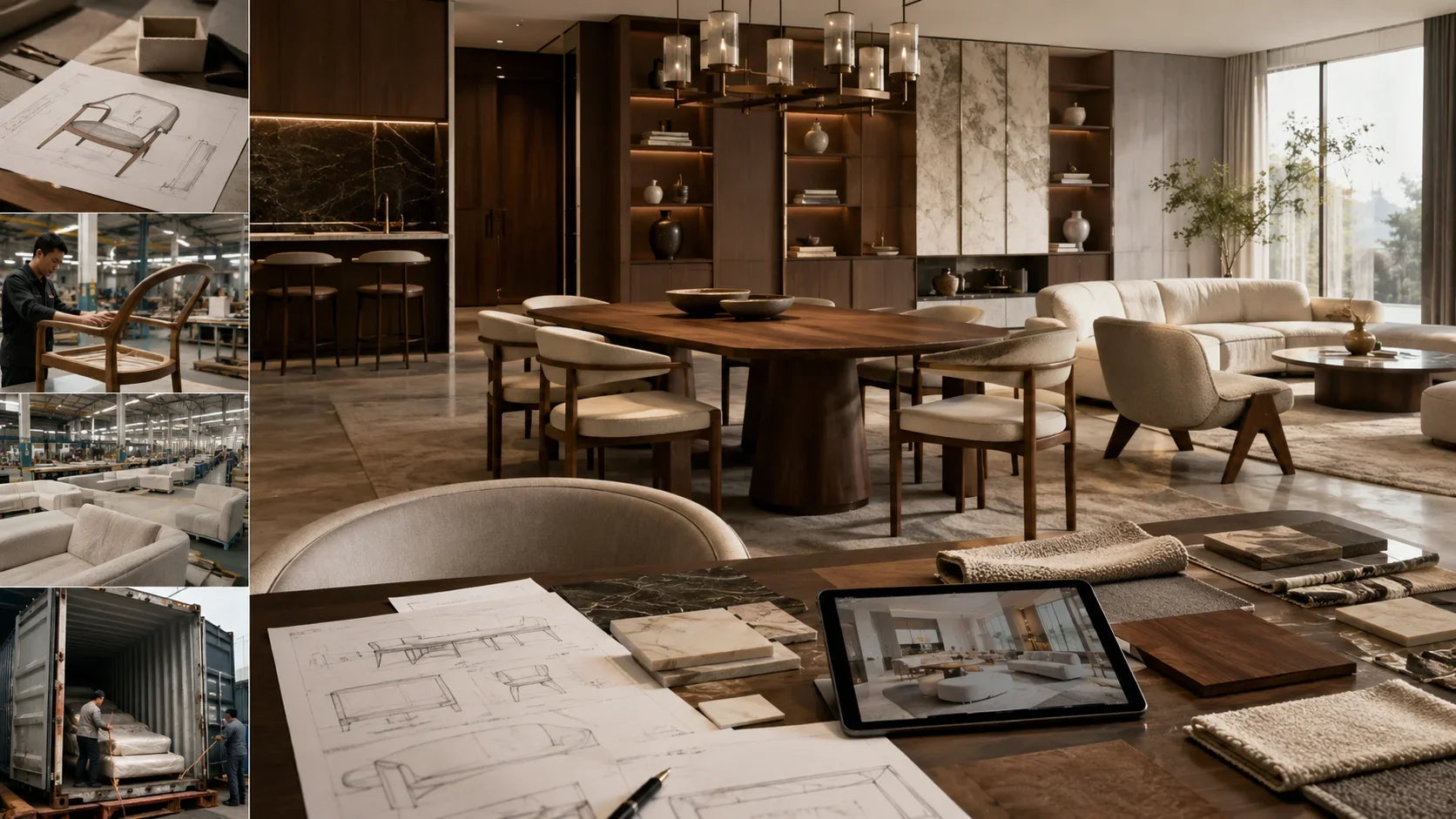
This guide explains a practical 7-step journey from early sketch to shop floor production. It covers project briefing, concept development, technical drawings, material selection, sample review, production documents, and final handover to the factory team. It is written for buyers who need bespoke furniture for hotels, villas, apartments, restaurants, offices, and commercial interiors.
Why Custom Furniture Needs a Clear Process
Custom furniture is different from buying ready-made products. Ready-made furniture already has fixed dimensions, materials, structure, and production methods. Custom furniture begins with a specific need: a room layout, a design concept, a brand standard, a client preference, or a project limitation.
Without a clear process, many problems can happen. The furniture may look good in a rendering but be difficult to manufacture. The selected material may not be suitable for daily use. The size may not match the site. The sofa may be too deep for the room. The chair may look elegant but feel uncomfortable. The cabinet may require installation details that were not discussed before production.
A reliable custom furniture design process connects creativity with manufacturing reality. It helps the project team answer practical questions before money, time, and materials are wasted.
Important questions include:
| Key Question | Why It Matters |
|---|---|
| What is the furniture used for? | Defines durability, comfort, and function |
| Where will it be placed? | Affects size, material, and installation |
| Who will use it? | Influences ergonomics and strength |
| What is the design style? | Guides shape, color, and material selection |
| What is the budget level? | Helps control material and production choices |
| What is the timeline? | Determines whether sampling and revisions are possible |
| What standards are required? | Impacts fire rating, fabric, foam, and documentation |
| How will it be shipped? | Affects structure, packaging, and assembly method |
A good process does not limit creativity. It protects creativity by making sure the final product can actually be produced and delivered.
The 7-Step Custom Furniture Workflow
The full workflow can be understood as seven connected steps. Each step has its own purpose, decision points, and deliverables.
| Step | Main Purpose | Key Deliverable |
| 1. Project Brief | Define project needs and constraints | Brief, room information, reference direction |
| 2. Concept Sketch | Translate ideas into visual direction | Sketches, mood board, style references |
| 3. Design Feasibility | Check structure, size, and production logic | Feasibility notes and adjustment suggestions |
| 4. Technical Drawing | Create measurable furniture details | CAD drawings, dimensions, structure details |
| 5. Material Selection | Confirm surfaces, comfort, and performance | Material board and specification sheet |
| 6. Sample Review | Test real product details before mass production | Prototype, mock-up, revision record |
| 7. Shop Floor Handover | Prepare production-ready documents | Production package and QC requirements |
This structure is especially important for hotel and commercial projects because the same item may be repeated across many rooms. A small mistake in one nightstand, chair, sofa, or headboard can become a large problem when produced in quantity.
Step 1: Project Brief and Requirement Collection
Every successful custom project starts with a clear brief. The brief defines what the furniture needs to achieve before any drawing or quotation begins.
For a hotel project, the brief may include room type, hotel positioning, brand standard, guest experience, fire requirements, material direction, target opening date, and quantity. For a villa project, it may include lifestyle needs, room layout, preferred style, comfort expectation, and budget range. For a furniture brand, it may include target market, product category, collection direction, price positioning, and packaging requirements.
A strong project brief should include:
| Information | Example |
| Project type | Hotel, villa, restaurant, office, apartment, retail brand |
| Product category | Sofa, bed, chair, table, cabinet, wardrobe, outdoor furniture |
| Usage environment | Guest room, lobby, dining area, bedroom, outdoor terrace |
| Quantity | One piece, sample order, room package, bulk order |
| Style direction | Modern, quiet luxury, classic, resort, minimalist |
| Budget range | Helps avoid unrealistic material proposals |
| Destination country | Affects packaging, logistics, and standards |
| Timeline | Helps plan drawing, sampling, production, and shipping |
| Special requirements | Fire rating, stain resistance, outdoor use, pet-friendly, etc. |
At this stage, the supplier should ask questions instead of quoting too quickly. A quick price based only on a screenshot may look efficient, but it usually creates risk. A professional manufacturer should first understand the project scope, product function, and technical requirements.
For bespoke furniture projects, the brief should also clarify which details are flexible and which details cannot change. For example, the overall style may be fixed, but the internal structure can be optimized. Or the dimensions may be fixed by the room layout, but the material can be adjusted to control cost.
Step 2: Concept Sketch and Design Direction
After the brief is confirmed, the next step is to develop the visual direction. This may include hand sketches, reference images, mood boards, material inspiration, 3D concepts, or early product proportions.
The purpose of the concept stage is not to finalize every detail. It is to align direction between the client, designer, and manufacturer. The team should understand the intended shape, style, proportion, function, and feeling of the product.
For example, a custom sofa may start with a reference image, but the final design needs to define the seat depth, arm shape, back height, cushion structure, leg style, fabric direction, and comfort level. A dining table may start as a sketch, but the team must consider tabletop thickness, base stability, material weight, edge detail, and packing method.
Concept development usually includes:
| Concept Element | What It Clarifies |
| Overall shape | The main silhouette and design identity |
| Proportion | Relationship between height, width, depth, and thickness |
| Style reference | Design direction and market positioning |
| Functional needs | Storage, seating comfort, cable management, mobility |
| Material atmosphere | Wood, fabric, leather, stone, metal, glass |
| Color direction | Warm, neutral, dark, light, contrast, tone-on-tone |
| Detail language | Stitching, seams, edges, trims, handles, legs |
At this stage, buyers should avoid approving a design only because it looks beautiful in one image. The concept must also be practical for the room, user, budget, and production method.
For luxury hotels and villas, concept sketches often help create a more unique design language. This is where bespoke furniture can add value, because it allows the furniture to match the architecture, interior mood, and client lifestyle more precisely.
Step 3: Design Feasibility and Engineering Review
Before moving into detailed drawings, the manufacturer should review whether the design can be produced safely, efficiently, and consistently. This is one of the most important parts of the custom furniture design process.
Feasibility review connects the designer’s idea with the factory’s experience. It checks whether the size is reasonable, whether the structure is strong enough, whether the material is suitable, and whether the product can be packed and delivered safely.
Common feasibility questions include:
| Review Area | Key Question |
| Structure | Can the frame support daily use? |
| Proportion | Does the furniture fit the room and human scale? |
| Material | Is the selected material suitable for this shape and usage? |
| Comfort | Will the seat depth, height, and angle feel right? |
| Production | Can the factory make it consistently in quantity? |
| Safety | Are the edges, stability, and load-bearing details acceptable? |
| Packaging | Can the item be shipped without damage? |
| Installation | Can it be moved through doors, elevators, and corridors? |
| Cost | Does the design match the expected budget? |
This step is where many design adjustments happen. For example, a very thin table leg may look elegant but may not be stable enough. A curved sofa may need internal reinforcement. A floating cabinet may need a different installation method. A natural stone top may require stronger support and special packaging.
A good manufacturer should not simply reject a difficult design. Instead, they should suggest practical alternatives that keep the visual effect while improving manufacturability. This is where factory experience becomes valuable.
Step 4: Technical Drawings and Product Details
Once the concept and feasibility direction are agreed, the design needs to become a technical drawing. This is where ideas turn into measurable instructions.
Technical drawings are essential because factories cannot produce accurately from inspiration images alone. Drawings define dimensions, structure, materials, connection methods, visible details, and sometimes installation requirements.
A furniture technical drawing may include:
| Drawing Detail | Purpose |
| Overall dimensions | Defines length, width, height, and depth |
| Front, side, and top views | Shows product shape from different angles |
| Section details | Explains internal structure and material layers |
| Material callouts | Identifies fabric, veneer, metal, stone, foam, and hardware |
| Edge details | Clarifies thickness, radius, seams, and finishing |
| Assembly method | Shows how parts connect |
| Hardware position | Controls hinges, slides, screws, handles, and brackets |
| Installation notes | Explains wall fixing, leveling, or site requirements |
| Tolerance notes | Helps control acceptable production variation |
For hotel and commercial projects, drawings should also connect with the BOQ and room type schedule. The same product code should appear in the drawing, quotation, production list, packing list, and installation guide.
If drawings are unclear, the factory may interpret details differently from the designer. This can lead to wrong proportions, incorrect materials, or repeated sample revisions.
For buyers, this is the stage where the design becomes serious. Before approving the drawing, check every dimension, material, finish, function, and quantity carefully.
Step 5: Material Selection and Specification
Material selection is where design, comfort, durability, and budget meet. A product can look very different depending on the chosen fabric, veneer, leather, metal finish, stone, foam, or hardware.
For custom furniture, material selection should not be based only on appearance. The team should also consider usage environment, maintenance, fire requirements, stain resistance, abrasion, comfort, and long-term stability.
Key material categories include:
| Material Category | What to Confirm |
| Fabric | Texture, color, abrasion resistance, stain resistance, fire performance |
| Leather or faux leather | Grade, thickness, backing, color consistency, maintenance |
| Foam | Density, resilience, softness, long-term shape recovery |
| Wood veneer | Species, grain direction, color matching, finish protection |
| Solid wood | Stability, moisture control, visible quality |
| Metal | Stainless steel, iron, aluminum, finish, welding, corrosion resistance |
| Stone | Natural or artificial, thickness, edge detail, sealing |
| Hardware | Hinges, slides, handles, connectors, soft-close function |
| Paint or lacquer | Color, gloss, scratch resistance, surface smoothness |
A material board is one of the most useful deliverables at this stage. It allows the client, designer, and manufacturer to review physical samples together instead of relying only on digital images.
Material approval should be documented clearly. If the client approves a beige fabric, the exact fabric code should be recorded. If a walnut veneer is selected, the grain and finish should be confirmed. If a bronze metal finish is chosen, the surface treatment should be defined.
In bespoke furniture work, material coordination is especially important because many pieces must feel visually connected across the space.
Step 6: Prototype, Sample, or Mock-Up Review
Before mass production, the project team should review a real sample whenever possible. The sample may be a full product, a partial mock-up, a material panel, or a prototype detail depending on the project scale and budget.
Sampling is not only for appearance. It is used to test comfort, dimensions, structure, material, color, craftsmanship, and production feasibility.
For a hotel room, a mock-up may include a complete headboard, nightstand, desk, chair, wardrobe, or seating piece. For a villa, the sample may focus on key custom items such as a sofa, dining table, bed, or cabinet. For a furniture brand, the prototype may be used to evaluate market potential and production cost.
Sample review should include:
| Review Point | What to Check |
| Size | Does it match the drawing and room layout? |
| Proportion | Does it look balanced in real scale? |
| Comfort | Is the seat height, depth, back angle, and foam suitable? |
| Material | Does it match the approved sample board? |
| Craftsmanship | Are stitching, edges, joints, and finishes clean? |
| Function | Do drawers, doors, hinges, and movable parts work properly? |
| Stability | Does the product shake, tip, or feel weak? |
| Maintenance | Can it be cleaned or repaired easily? |
| Packaging | Does the structure need to be packed assembled or knock-down? |
After review, all changes should be recorded. A verbal comment such as “make it softer” is not enough. The team should define what changes: foam density, cushion thickness, seat angle, fabric tension, or internal structure.
This revision record becomes the bridge between sample approval and production.
Step 7: Shop Floor Handover and Production Preparation
The final step before manufacturing is shop floor handover. This is where the approved design is translated into production instructions for the factory team.
The shop floor does not work from inspiration images. It needs clear documents, approved samples, material codes, product codes, process notes, QC standards, and packing requirements.
A production-ready package may include:
| Production Document | Purpose |
| Final approved drawing | Guides dimensions and structure |
| Product specification sheet | Summarizes materials, finishes, and hardware |
| Approved sample photos | Shows final appearance and details |
| Material board record | Confirms fabric, veneer, metal, stone, and leather |
| Revision record | Prevents old versions from being produced |
| Production schedule | Controls timeline and milestones |
| QC checklist | Defines inspection requirements |
| Packing instruction | Protects goods during transport |
| Labeling system | Connects product code, room number, and carton number |
This stage is critical because even a good design can fail if production information is incomplete. The factory team needs to know exactly what has been approved and what should be controlled.
For larger projects, the supplier should also prepare a production timeline. This may include material purchasing, frame making, woodworking, metalwork, upholstery, painting, assembly, QC, packing, and shipment preparation.
Typical Timeline for a Custom Furniture Project
The timeline depends on product complexity, quantity, material availability, sample requirements, and approval speed. However, a general planning timeline can help buyers understand the process.
| Stage | Typical Time Range | Notes |
|---|---|
| Project brief | 1–3 days | Faster if drawings and BOQ are ready |
| Concept and sketch | 3–7 days | Depends on design complexity |
| Feasibility review | 2–5 days | May require factory and technical review |
| Technical drawings | 5–14 days | Longer for complex furniture or full room packages |
| Material selection | 3–10 days | Depends on sample availability |
| Prototype or mock-up | 10–30 days | Varies by product category |
| Revision and approval | 3–10 days | Depends on client feedback speed |
| Production preparation | 3–7 days | Includes final documents and material confirmation |
| Mass production | 30–90 days | Depends on quantity and complexity |
| QC and packing | 3–10 days | Larger projects require more inspection time |
This timeline shows why early preparation is important. If a project has a fixed opening date or installation deadline, the design and sampling stage should not be delayed.
A clear custom furniture design process helps the project team protect time as well as quality.
Key Deliverables at Each Stage
For professional project management, each stage should produce clear deliverables. These deliverables reduce misunderstanding and help the buyer, designer, and factory stay aligned.
| Stage | Key Deliverables |
| Briefing | Project brief, room information, buyer requirements |
| Concept | Sketches, mood board, reference images |
| Feasibility | Technical suggestions, risk notes, cost direction |
| Drawing | CAD drawings, dimensions, detail sections |
| Materials | Material board, fabric codes, finish samples |
| Sampling | Prototype, mock-up, sample review report |
| Production handover | Final drawing package, specification sheet, QC checklist |
| Production | Progress photos, videos, inspection records |
| Shipment | Packing list, carton labels, export documents |
For overseas buyers, these deliverables are especially important because communication happens across distance and time zones. Clear documents help prevent mistakes before products are shipped internationally.
Common Mistakes to Avoid
The first mistake is starting production from a reference photo without technical drawings. A photo can show style, but it cannot define structure, dimensions, material, or production method.
The second mistake is approving materials only through screen images. Real fabric, veneer, leather, metal, and stone can look different under different lighting conditions.
The third mistake is skipping the sample stage for complex or repeated products. If a sample is wrong, it can be corrected. If mass production is wrong, the cost is much higher.
The fourth mistake is changing details without updating documents. Every change should be recorded in drawings, material sheets, and production notes.
The fifth mistake is ignoring packaging and installation until the end. Furniture should be designed with transport and site handling in mind.
The sixth mistake is choosing the cheapest solution without reviewing durability. A lower price may lead to weaker structure, poor hardware, thinner foam, or unreliable finishes.
How CC Furniture Supports Custom Design Projects
CC Furniture supports global buyers with a factory-based project approach. Our team helps clients review drawings, develop concepts, select materials, prepare samples, coordinate production, inspect quality, and arrange export packaging.
For hotel, villa, restaurant, apartment, and commercial projects, our value is not only producing furniture. It is helping clients connect design ideas with manufacturing reality. We can help identify risks early, suggest practical material options, adjust structures, and prepare production-ready documents.
For bespoke furniture projects, this support is especially important because every detail affects the final result. Size, comfort, material, structure, finish, and installation all need to be discussed before production begins.
As a Foshan-based furniture manufacturer, CC Furniture understands both design communication and shop floor execution. This allows overseas buyers to work with a team that can support the project from concept to delivery.
Recommended Image ALT Text
- custom furniture design process from sketch to factory production
- bespoke furniture material board with fabric veneer metal and stone samples
- custom sofa technical drawing and prototype review before production
- furniture sample inspection before shop floor handover
- factory team preparing custom furniture for hotel and villa project production
Suggested Internal Links
- Custom Hotel Furniture Project Solution
- Hotel Furniture Manufacturer in China
- OEM vs ODM Furniture Manufacturing Guide
- Complete FF&E Procurement Process for Hotel Projects
- Hotel Furniture Cost Per Room Budget Guide
- How to Visit Foshan Furniture Market
- Contact Us for Custom Furniture Quotation
Conclusion
A successful custom furniture design process is not only about creativity. It is about turning an idea into a product that can be measured, manufactured, inspected, packed, shipped, installed, and used for years.
From project brief and sketch to drawings, materials, samples, and shop floor handover, every step protects the final result. The clearer the process, the fewer surprises appear during production.
For hotels, villas, restaurants, apartments, and commercial spaces, custom furniture can create a stronger design identity and better functional fit. But it must be supported by professional drawings, material control, sample approval, and factory-level execution.
Need help developing custom furniture for your project?
Share your drawings, reference images, BOQ, room layout, material direction, budget range, and timeline with our team. We can help review your requirements and prepare a practical design-to-production solution.
FAQ
1. What is the first step in custom furniture development?
The first step is the project brief. It defines the product category, usage environment, size requirements, style direction, budget range, quantity, timeline, and any special technical requirements.
2. Do I need drawings before requesting a quotation?
Drawings are strongly recommended for accurate quotation. If you do not have drawings, reference images, room dimensions, and material preferences can help the supplier prepare an initial estimate.
3. How long does a custom furniture project take?
Simple custom items may take a few weeks, while complex hotel or villa projects may require several months including design review, drawings, material selection, sampling, production, QC, packing, and shipping.
4. Is a sample always necessary?
For complex, high-value, or repeated products, a sample or mock-up is highly recommended. It helps confirm comfort, proportion, materials, color, craftsmanship, and function before mass production.
5. What documents should be prepared for production?
The production package should include final drawings, material specifications, approved sample photos, revision records, QC checklist, packing instructions, product codes, and delivery requirements.
6. Can custom furniture be adjusted after sampling?
Yes. Sampling is the best stage to make adjustments. Any changes should be recorded clearly in drawings, material sheets, and production notes before mass production begins.
7. What affects the cost of custom furniture?
Cost is affected by size, structure, materials, upholstery, hardware, finish complexity, quantity, sampling, packaging, logistics, and installation requirements.
8. Why work with a factory-based furniture supplier?
A factory-based supplier can connect design review with production reality. This helps improve communication, control quality, adjust details, and reduce risks before mass production.



اترك تعليقًا
यह साइट hCaptcha से सुरक्षित है और hCaptcha से जुड़ी गोपनीयता नीति और सेवा की शर्तें लागू होती हैं.